
NOTE: If you want to participate in a regular Family Constellations workshop, remember to visit the book page, as the printed editions include a special Gift Bonus
SYSTEMIC HISTORICAL CONSTELLATIONS
Constelaciones Históricas (Spanish)
At a time when the world is once again moving closer to a global war,
it becomes urgent to look more deeply at the history we have inherited.
What was excluded is still waiting to be recognized.
To heal the conflicts of the present, humanity needs to honor
civilizations, cultures, and memories erased from the official narrative.
Recognizing what was forgotten is a necessary step
toward restoring peace in the human system.
Open Call to Constellate Tartaria
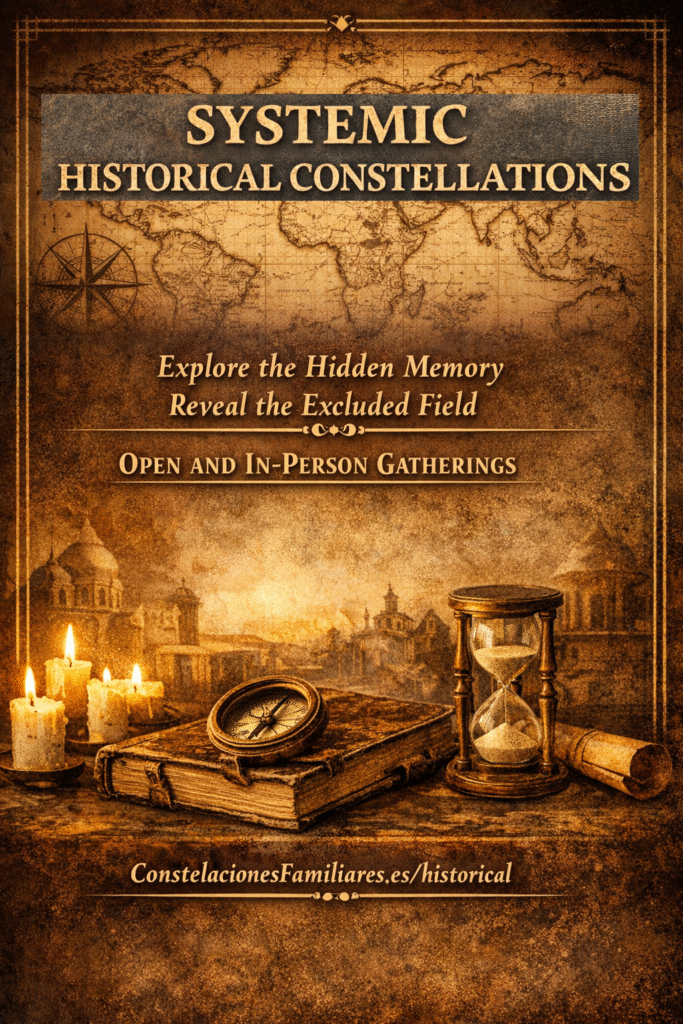
We are launching a new project of Historical Constellations that will be facilitated this year in different provinces.
In-person gatherings, open and free of charge.
They do not belong to any individual or specific school of thought: they belong to the social system as a whole.
Participation is open.
No prior training is required.
Only the willingness to participate with presence and to contribute awareness to the collective field.
Note: Regular Family Constellations have a cost, but you can also attend for free by using the bonus included with the novel “The Tartaria Trunk.”
New Visual Mantra of PRESENCE
Purpose of the Systemic Historical Constellations
The purpose is clear: to contribute together to a greater health of the social system.
When a society can look at its memory without fear, without confrontation, and without imposition, it becomes more stable, more mature, and more free.
It is not about imposing a new version of history.
It is about expanding the field.
Each province will be a node.
Each gathering, an opportunity to integrate what has remained fragmented.
First Stage: Tartaria
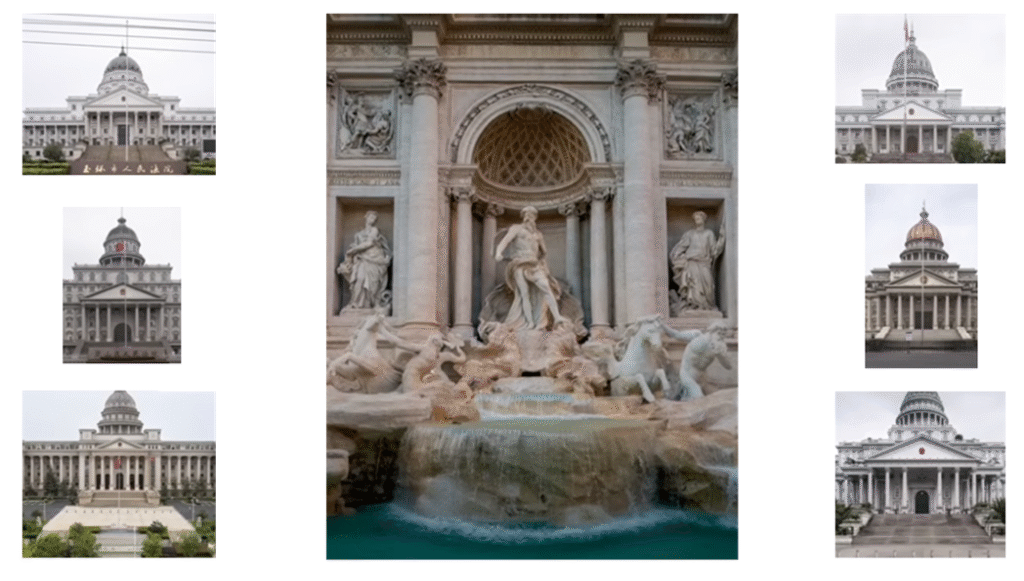
If territory can be fragmented,
time can be aligned too.
The radical hypothesis doesn’t ask only:
Why does Tartaria disappear from the map?
It asks something more uncomfortable:
From which temporal axis are we viewing its disappearance?
What is a Historical Constellation?
A gathering to observe patterns of collective memory
without debate,
without confrontation,
without imposing conclusions.
We work with the system, not against it.
We are not trying to prove.
We are seeking to observe structural tensions.
Registration
Places are limited to 20 participants to ensure deep, well-held work.
To register, write to us by WhatsApp or email including:
-
Name
-
Age (optional)
-
Province of interest
-
Approximate availability
-
WhatsApp or email contact details
WhatsApp: +34 627 61 92 66
Email: TartariaArchivo@gmail.com
You will receive confirmation with the details of the next gathering (exact location, date, and time) once the minimum group size has been reached.
Participation is free of charge.
The commitment is to attend with presence and respect.
If you feel that history is not only the past, but a living structure influencing the present, this space is for you.
The invitation is open.
Research Framework
Radical Chronological Hypothesis
The 19th century as a point of global synchronization
The 19th century was not only industrial.
It was a century of:
-
Calendar unification
-
Consolidation of the Gregorian calendar as the dominant reference
-
International time standardization (railways, telegraph, meridians)
-
Banking and financial centralization
-
Mass rewriting of history textbooks
-
Academic consolidation of official chronologies
Never before in human history had time been so administrated.
And when time is administered,
sequence stabilizes.
And when sequence stabilizes,
the narrative consolidates.
Radical Chronological Hypothesis
It is not proposed that “centuries are missing.”
Something more sophisticated is proposed:
That temporal reorganization can occur without altering physical dates.
It is enough to:
-
Reorder interpretive sequences
-
Redefine which event is foundational
-
Establish a new implicit “zero point”
-
Synchronize previously desynchronized calendars
-
Absorb parallel accounts into a single legitimized timeline
If multiple calendars coexisted for centuries
(Julian, Gregorian, local, regional),
the transition to a single temporal framework can generate:
-
Interpretive shifts
-
Historical relocations
-
Overlapping chronologies
-
Re-reading of old documents under a new alignment
Without needing to destroy archives.
Tartaria under a possible temporal recalibration
If a vast entity appears for centuries in official maps
and then fragments abruptly in the same period in which:
-
Modern nation-states consolidate
-
The international financial system is reorganized
-
A unified academic chronology is imposed
Then the structural question is radical:
Was territorial fragmentation accompanied by a temporal relocation of its history?
Not necessarily to eliminate.
But to redistribute.
Not to erase.
But to absorb into a new sequence.
Because if time is reorganized,
events can appear:
-
Older
-
More recent
-
Less central
-
Subordinated to another narrative axis
Without the document changing.
Administration of Time as a Form of Power
Controlling territory organizes space.
Controlling the calendar organizes the past.
If a new political order needs to legitimize itself, it can:
-
Redefine genealogies
-
Re-hierarchize events
-
Minimize previous entities
-
Reinterpret entire periods
This is not about claiming there was an explicit or deliberate falsification of history.
We propose a structural hypothesis:
That the consolidation of the 19th century may have involved a simultaneous recalibration of:
-
Space
-
Time
-
Narrative
And that Tartaria could represent the visible point where that convergence becomes detectable.
The architecture of stabilized time
Once chronology is unified:
-
The timeline becomes unquestionable
-
Previous discrepancies are interpreted as minor errors
-
Former large-scale entities dissolve into new political categories
-
The narrative is simplified
And what was macro becomes marginal.
Not because it never existed.
But because it stopped fitting the new architecture.
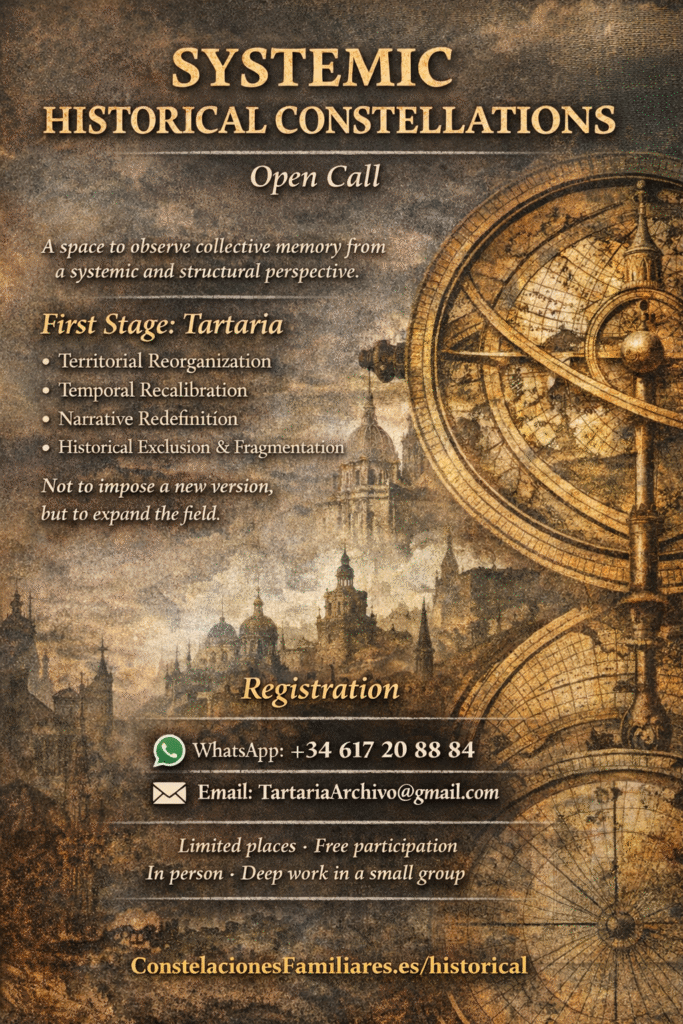
Collective Memory as a System That Protects Itself
History is not only a sequence of dates.
It is a system.
A living system that organizes memory, identity, and legitimacy.
And like any system, it develops self-regulating mechanisms.
In Family Constellations we learn that when a member is excluded, the entire system reorganizes to preserve balance.
The excluded does not disappear.
It shifts.
It hides.
But it continues acting.
History can work the same way.
Historical exclusion is not forgetting.
It is reorganization.
The Historical Field
In constellations we speak of the “Knowing Field”:
a space where information is not only in documents, but in the structure of the system itself.
Applied to history, this implies something unsettling:
A collective memory may exist that the official narrative does not integrate appropriately.
Not because someone signs a decree of concealment,
but because the system needs coherence.
When an infrastructure does not fit the narrative of linear progress, it is redefined.
When a chronology presents tensions, it is normalized.
When a presence is too disruptive, it is fragmented.
It is not about conspiracy.
It is about systemic equilibrium.
The structural question
What happens when an excluded element begins to reappear?
In constellations, when the excluded is acknowledged, the system does not collapse.
It reorganizes into greater coherence.
Applied to history:
To investigate is not to attack.
It is to recognize.
To constellation historically is not to impose a new narrative.
It is to observe where the system shows symptoms:
-
Abrupt documentary gaps
-
Simultaneous redefinitions across multiple institutions
-
Narrative consolidations coinciding with political reorganizations
-
Infrastructures whose chronology generates tension
Not to claim an absolute alternative truth.
But to allow the historical system to recover complexity.
Closing
History may not have been falsified.
But it may have been organized to sustain a certain coherence.
And every system that organizes memory does so in function of the present it needs to justify.
The question is not whether history is true or false.
The question is deeper:
If we placed in the field everything that was redefined, fragmented, or reduced…
would the current structure still hold with the same stability and legitimacy?
Or would we discover that the system always knew more than it was willing to integrate.